
Beyond the Surface: Why Aerial Thermography is the Ultimate Due Diligence Tool for Commercial Acquisitions
Beyond the Surface:
Why Aerial Thermography is the Ultimate Due Diligence Tool for Commercial Acquisitions
A building can look immaculate from the street. Freshly sealed concrete, clean glazing, not a visible crack in sight. And yet, somewhere inside that flat roof membrane — or buried behind that smooth EIFS façade — millions of dollars in latent damage may already be underway. The question isn't whether your next commercial acquisition has hidden envelope deficiencies. The question is whether you'll discover them before or after the wire transfer clears.
The 'Invisible' Liability: Moisture That Hides in Plain Sight
The building envelope — the roof, exterior walls, windows, and below-grade waterproofing that collectively separate the interior of a structure from the exterior environment — is the single most consequential system in a commercial building for long-term capital performance. It is also the system most likely to fail silently.
Unlike a malfunctioning HVAC unit or a tripped breaker, moisture infiltration rarely announces itself immediately. Water that enters a low-slope roof assembly doesn't necessarily reach the ceiling of the occupied space for months or even years. Instead, it saturates the insulation, degrades the adhesion of the roofing membrane, accelerates degradation at the structural deck, and quietly destroys the thermal performance of the assembly — all while the roof above appears visually intact from a standard rooftop walk-through.
EIFS (Exterior Insulation and Finish Systems), commonly known as synthetic stucco, presents a similar challenge. EIFS is one of the most widely used exterior cladding systems on commercial buildings constructed between 1980 and the present, and it is also one of the most historically problematic. When the sealant joints at windows, penetrations, and transitions fail — which they inevitably do over time — water infiltrates behind the cladding and becomes trapped against the substrate. Because the EIFS face coat is largely impermeable, that moisture has nowhere to go. The result is sustained wet conditions that degrade the substrate, foster biological growth, and can ultimately compromise the structural integrity of framing members without producing a single visible indication at the surface.
In our experience conducting due diligence assessments across the country, it is not uncommon to document active moisture saturation across >10% of a flat roof assembly on a building that has had no reported interior leak history. The water is there. It simply hasn't made it inside yet — but it's working on it.
This is the liability a conventional building inspection — or even a standard Property Condition Assessment (PCA) — is structurally ill-equipped to identify. A visual walk-through, by definition, can only document what is visible. Moisture that is actively destroying your asset from within remains entirely invisible until the damage is catastrophic and the remediation cost is an order of magnitude higher than it would have been at early detection.
Aerial Thermography: A Fundamentally Different Class of Investigation
Infrared thermography exploits a simple but powerful principle: wet insulation retains heat differently than dry insulation. As a roof surface cools after sunset, saturated areas — where trapped moisture has absorbed solar energy throughout the day — release that heat more slowly than the surrounding dry field. To a calibrated thermal camera, those areas appear as distinct warm anomalies against a cooling background, effectively "mapping" the location and extent of moisture intrusion with a resolution that no other non-destructive methodology can match.
When that thermal camera is mounted on a UAV (unmanned aerial vehicle) flown by an FAA-certified Remote Pilot at low altitude over a commercial roof, the result is a complete, georeferenced thermal map of the entire roof assembly, often able to be captured in a single mobilization under controlled post-sunset conditions.
Standard drone photograph (left) vs. aerial thermal map of the same roof surface (right) — in this image, darker colored areas indicate moisture-saturated insulation invisible to the naked eye.
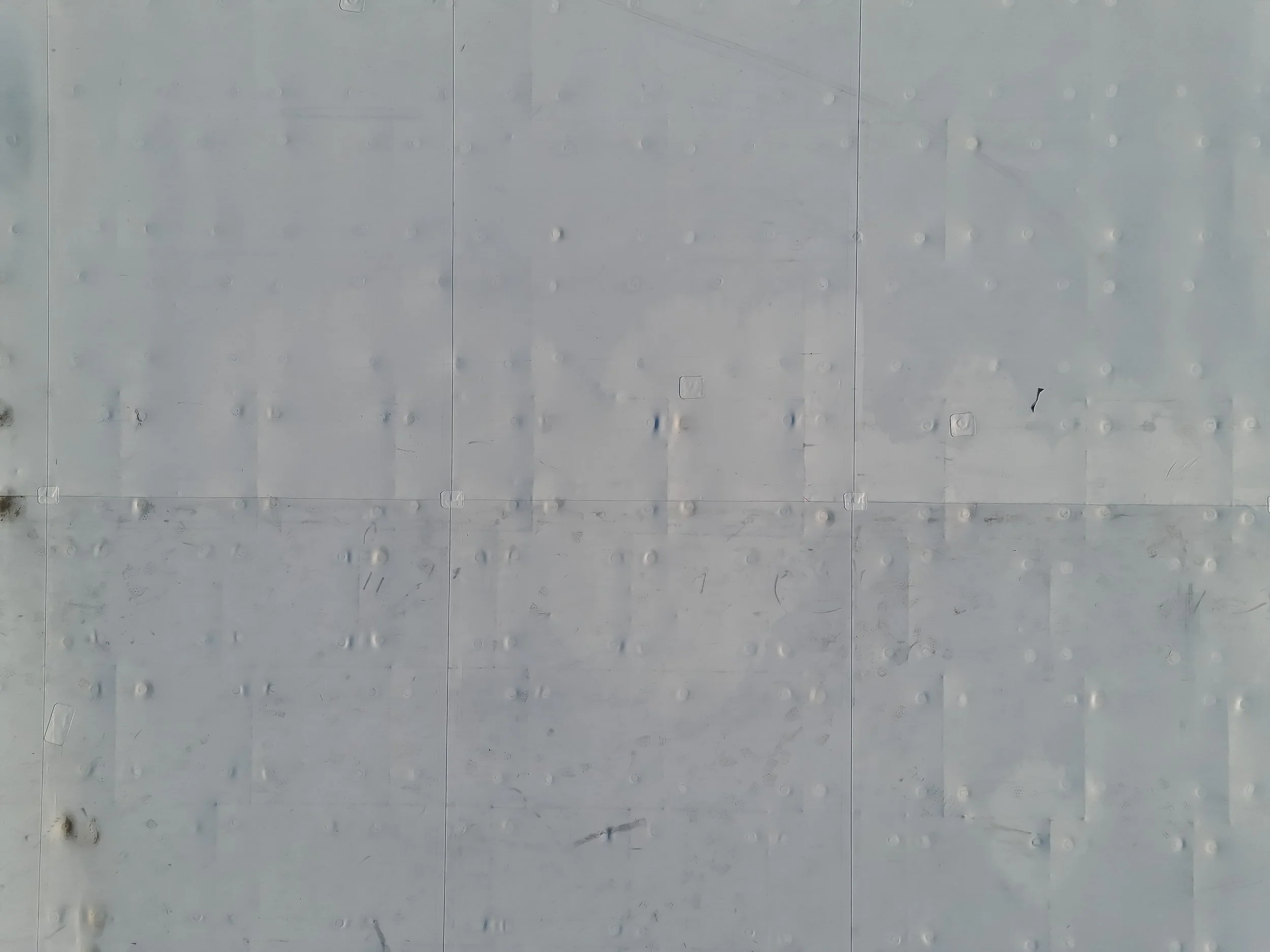
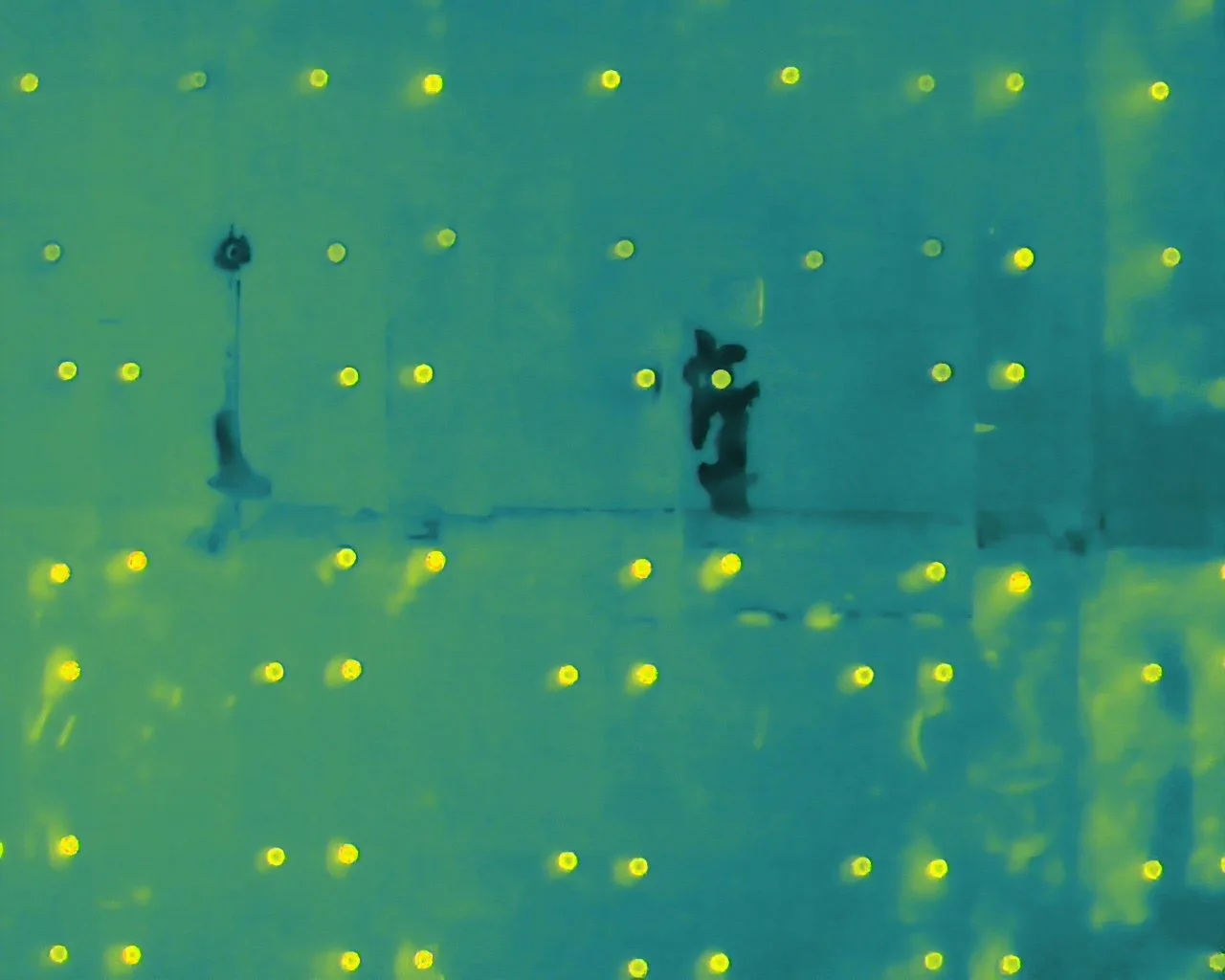
At Jackson Envelope Consulting, Spencer Jackson holds dual credentials as an FAA-certified sUAS Remote Pilot and a Level III Infrared Thermographer — the highest certification level available in the field of applied infrared thermography. This combination is not standard in the building envelope consulting industry. It means that the individual piloting the aircraft is also the individual interpreting the thermal data with the professional depth to distinguish a genuine moisture anomaly from a thermal artifact, a mechanical feature, or a photovoltaic system reflection — and to translate those findings into actionable capital recommendations with documented cost implications.
Data-Driven Negotiation: Converting Findings Into Financial Leverage
The practical value of aerial thermography in a commercial acquisition is not merely the peace of mind of knowing what you're buying. It is the documented, quantified leverage it creates at the negotiating table.
When a JEC building envelope condition assessment identifies, for example, that 18% of a 200,000-square-foot industrial roof assembly is thermally anomalous — consistent with moisture saturation across approximately 36,000 square feet — that is not a subjective opinion. It is a georeferenced thermal map, cross-referenced against core samples confirming wet insulation, with a rough order-of-magnitude capital estimate attached. That document can be presented to a seller with a specific request: reduce the acquisition price by the documented cost of remediation, or perform and warrant the repairs prior to closing.
A $12,000 building envelope assessment that surfaces $340,000 in deferred roof maintenance isn't a due diligence cost. It's a $328,000 return on investment — before you own a single square foot of the asset.
We've watched this dynamic play out in acquisitions ranging from neighborhood retail centers to multi-building multifamily portfolios. Buyers who invest in a rigorous envelope assessment don't just avoid unpleasant surprises post-closing — they negotiate from a position of technical authority rather than good faith assumptions. In competitive markets, that distinction is material.
JEC's deliverable in the due diligence context is a formal Building Envelope Condition Assessment Report — a professionally structured document that includes a narrative findings section for each major system (roof assemblies, exterior wall assemblies, fenestration, below-grade and courtyard waterproofing, and parking structures where applicable), a prioritized recommendation table organized by urgency tier, and a 10-year capital expenditure planning table with rough order-of-magnitude cost guidance for each identified deficiency. This is the document that goes to your lender, your investment committee, and across the negotiating table — and it is designed to withstand scrutiny in all three settings.
Bridging the Gap: When Even New Buildings Fail
There is a persistent and costly assumption in commercial real estate that building envelope deficiencies are primarily a function of age — that a recently constructed building with unexpired warranties is, by definition, a low-risk envelope. That assumption is wrong, and it is one of the core reasons JEC was founded.
The reality that building envelope professionals encounter daily is this: construction documents describe design intent. Field conditions reflect execution. The gap between the two — between what the architect specified and what the installer actually did — is where the vast majority of building envelope deficiencies originate, and it is a gap that has nothing to do with how recently the building was constructed.
A new multifamily mid-rise can have every horizontal surface flashed incorrectly from day one. A recently completed mixed-use development can have EIFS sealant joints that were improperly detailed at the design phase and will begin failing within eighteen months. A brand-new below-grade parking structure can have waterproofing terminations that don't meet the manufacturer's installation requirements and will void the warranty long before the first property manager is even aware there's an issue.
"We exist to bridge the gap between design intent and real-world performance — whether that means catching deficiencies before they become liabilities in a due diligence context, or documenting construction non-conformance on a project that hasn't even been handed over yet."
This is why JEC's service offering spans both the pre-acquisition and the post-construction contexts. On the acquisition side, we give buyers the technical intelligence to make informed capital decisions. On the construction side, we serve as an independent third-party set of eyes — someone whose sole obligation is to document whether the envelope being built matches the envelope that was designed. In both contexts, the tool is the same: rigorous, credential-backed, technically defensible observation and analysis.
Aerial thermography is one of the most powerful instruments in that toolkit. But it is one component of a comprehensive approach — not a substitute for the experienced professional interpreting the data, writing the report, and standing behind the findings with a depth of expertise that holds up when the stakes are high.
Commissioning Due Diligence Before Your Next Acquisition?
JEC provides building envelope condition assessments and aerial thermographic surveys for commercial acquisitions throughout the Charlotte region and across the Southeast. Contact us to discuss your timeline and scope.
Request a Consultation